
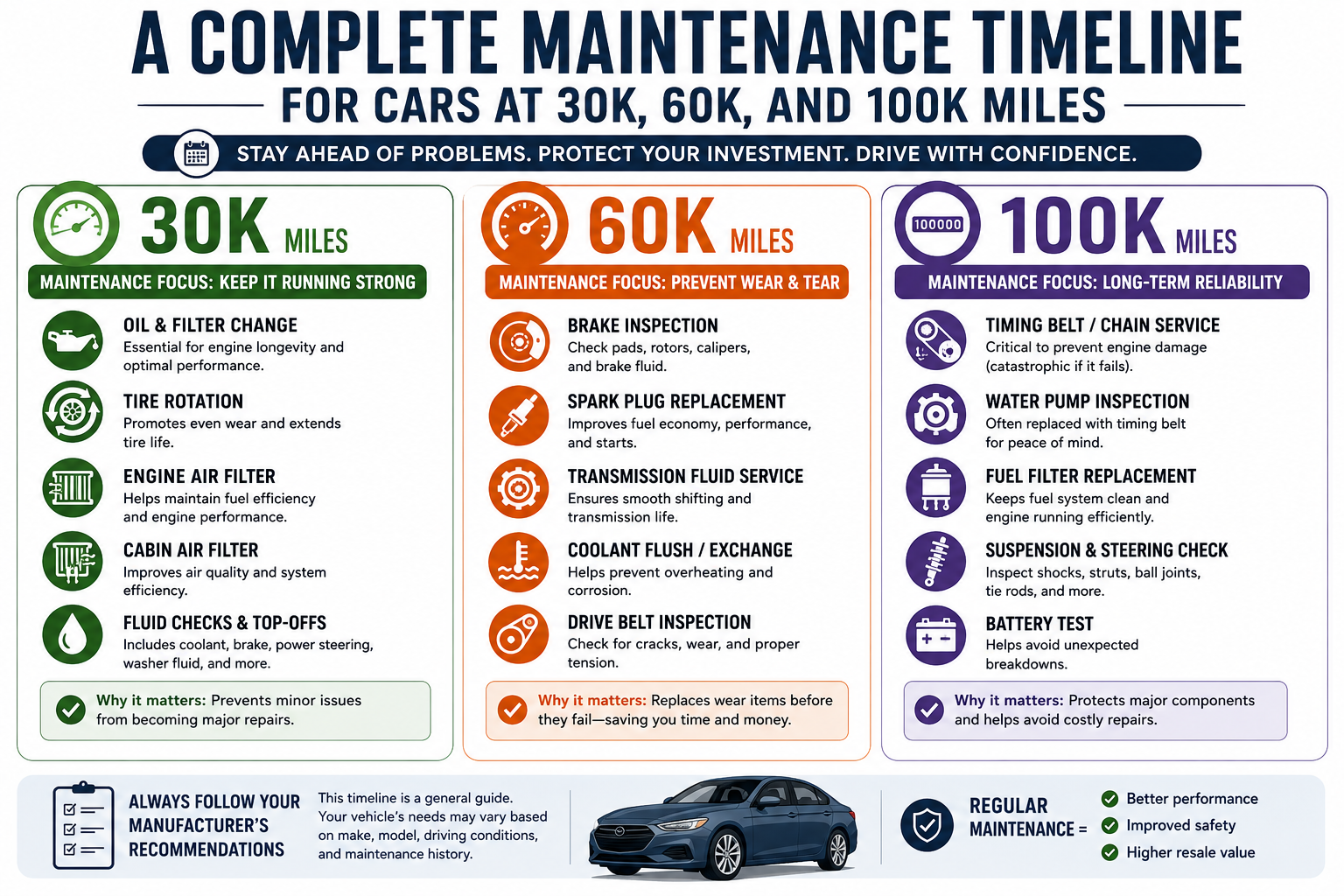
A Complete Maintenance Timeline for Cars at 30K, 60K, and 100K Mile
Most drivers know routine maintenance matters. The challenge is knowing what should be done, when it should be done, and which services actually help prevent expensive repairs down the road.
Modern vehicles are more reliable than ever, but they aren’t maintenance-free. Tires wear unevenly, fluids lose their protective properties, batteries weaken, suspension components develop play, and brake systems gradually wear over thousands of miles.
The good news is that most major repairs don’t happen overnight. In many cases, your vehicle provides warning signs long before a component fails. Understanding the major maintenance milestones at 30,000, 60,000, and 100,000 miles can help improve safety, extend vehicle life, reduce ownership costs, and prevent unexpected breakdowns.
Whether you drive a commuter car, family SUV, work truck, or commercial fleet vehicle, following a structured maintenance schedule can help you get the most value out of every mile.
Why Mileage-Based Maintenance Matters
One of the biggest misconceptions among drivers is that a vehicle will always feel different when maintenance is needed.
In reality, many automotive systems wear gradually. Drivers often adapt to declining ride quality, reduced steering precision, lower fuel economy, and longer stopping distances without realizing vehicle performance has changed.
Routine maintenance allows technicians to identify small problems before they become major repairs.
What Most Drivers Don’t Know
Most engine wear occurs during startup and warm-up rather than during highway driving.
Frequent short trips can actually be harder on engine oil than long-distance highway commutes because the engine may never fully reach operating temperature. That’s one reason regular maintenance remains important even for vehicles that aren’t driven very far.
For drivers across the Dallas-Fort Worth area, heavy traffic, long commutes, summer heat, rough roads, and highway mileage can accelerate wear on tires, batteries, fluids, and suspension components.
30,000-Mile Maintenance Checklist
Thirty thousand miles is often the first major maintenance milestone. Most major systems remain in good condition, but inspections become increasingly valuable because they establish a baseline for future maintenance.
Tire Inspection and Rotation
Your tires have likely experienced thousands of braking cycles, pothole impacts, heat cycles, and steering inputs by this point.
Technicians should inspect:
- Tread depth
- Tire pressure
- Sidewall condition
- Tire age
- Uneven wear patterns
Tires Often Reveal Problems First
Many drivers assume tires simply wear out over time.
In reality, tire wear often provides the earliest warning sign of developing vehicle problems.
Uneven wear may indicate:
- Alignment concerns
- Suspension wear
- Steering component wear
- Improper inflation
What Most Drivers Don’t Know
A vehicle can be significantly out of alignment without pulling to one side.
Many drivers unconsciously compensate with small steering corrections. As a result, tires may wear abnormally for months before steering symptoms become noticeable.
Even more surprising, excessive toe alignment is often a bigger tire killer than camber. Small toe errors force tires to scrub across the pavement instead of rolling normally, dramatically shortening tire life.
Many drivers also confuse balancing and alignment. While both services affect tire performance, they solve different problems. Learn more about the difference between wheel balancing and wheel alignment and why both services are important for tire life, ride quality, and vehicle handling.
Actionable Tip
Run your hand across the tire tread.
If the tread feels smooth in one direction but rough in the other, feathering may be developing. This is often an early sign of alignment issues.
Brake Inspection
Brake pads may still have substantial life remaining at this mileage, but inspection is critical.
Technicians should evaluate:
- Brake pad thickness
- Rotor condition
- Brake fluid condition
- Brake line integrity
- Caliper operation
What Most Drivers Don’t Know
During hard braking, as much as 70-80% of stopping force comes from the front brakes.
This is why front brake pads and rotors usually wear faster than rear brake components.
Actionable Tip
If your steering wheel shakes while braking, don’t automatically assume you need brake pads. The issue may involve rotor condition, suspension wear, wheel balance concerns, or alignment problems.
Oil and Filter Service
Routine oil changes remain one of the most important forms of preventative maintenance.
Fresh oil helps:
- Reduce friction
- Control heat
- Prevent sludge formation
- Protect internal engine components
What Most Drivers Don’t Know
Engine oil does much more than lubricate.
Modern motor oils contain detergents, anti-wear additives, corrosion inhibitors, and cleaning agents that gradually lose effectiveness over time.
If you’re unsure how often your vehicle should be serviced, this guide on professional oil change services explains why regular oil maintenance remains one of the best investments in long-term engine reliability.
Battery Testing
Many drivers associate battery failure with winter.
In Texas, summer heat is often the bigger threat.
What Most Drivers Don’t Know
Many batteries that fail during winter actually suffered most of their damage during the previous summer.
Heat accelerates internal battery degradation long before symptoms appear.
Testing battery condition early can help prevent inconvenient no-start situations later.
60,000-Mile Maintenance Checklist
By 60,000 miles, vehicles often require more comprehensive maintenance.
Many wear items begin approaching replacement intervals, and fluid services become increasingly important.
Fluid Replacement Services
Depending on manufacturer recommendations, technicians may inspect or replace:
- Transmission fluid
- Brake fluid
- Differential fluid
- Transfer case fluid
- Coolant
Why Fluids Matter More Than Most Drivers Realize
Many drivers think fluids simply lubricate moving parts.
In reality:
- Brake fluid absorbs moisture over time.
- Coolant protects against corrosion throughout the cooling system.
- Transmission fluid provides lubrication, cooling, and hydraulic pressure.
What Most Drivers Don’t Know
Many manufacturers use the term “lifetime fluid.”
That doesn’t necessarily mean the fluid lasts forever.
Severe driving conditions, towing, stop-and-go traffic, and high temperatures can accelerate fluid degradation long before major problems develop.
Alignment and Suspension Inspection
At this mileage, suspension wear can begin affecting ride quality, steering response, and tire life.
Technicians should inspect:
- Ball joints
- Tie rods
- Bushings
- Shocks
- Struts
What Most Drivers Don’t Know
Suspension wear often appears in the tires before drivers notice ride quality changes.
Many tire replacement decisions could have been delayed if the underlying alignment or suspension issue had been caught earlier.
A professional alignment can help maximize tire life, improve fuel economy, and restore predictable handling.
Tire Evaluation
Many vehicles approach their first complete tire replacement around this mileage.
A qualified tire professional can evaluate:
- Remaining tread depth
- Tire age
- Wear patterns
- Driving conditions
What Most Drivers Don’t Know
Tires often age out before they wear out.
Heat, sunlight, ozone exposure, and environmental conditions gradually change the rubber compound even when tread remains.
This is particularly important in Texas, where extreme heat can accelerate tire aging.
Air Filter Replacement
Both engine and cabin air filters should be inspected regularly.
Replacing dirty filters helps maintain:
- Engine efficiency
- Fuel economy
- Interior air quality
- HVAC performance
100,000-Mile Maintenance Checklist
Reaching 100,000 miles is a major milestone.
The good news is that many modern vehicles can easily exceed 200,000 miles with proper care. The challenge is that deferred maintenance often begins catching up with owners around this point.
Cooling System Service
Cooling system components experience constant heat cycling and pressure changes.
Technicians should inspect:
- Radiator
- Water pump
- Thermostat
- Coolant condition
- Hoses
What Most Drivers Don’t Know
Coolant does far more than prevent overheating.
Modern coolant protects against corrosion, lubricates water pump components, and helps preserve the entire cooling system.
Actionable Tip
If you find yourself periodically adding coolant, don’t assume it’s normal.
Cooling systems are sealed. Recurring coolant loss usually indicates a leak or developing component issue.
Spark Plug Replacement
Many manufacturers recommend spark plug replacement around this mileage interval.
Worn spark plugs can affect:
- Fuel economy
- Engine performance
- Starting reliability
- Emissions
Replacing plugs on schedule often helps prevent larger ignition-related issues later.
Comprehensive Brake System Inspection
At this mileage, brake system inspections should become increasingly thorough.
Technicians should inspect:
- Brake pads
- Rotors
- Calipers
- Brake fluid
- Hydraulic components
What Most Drivers Don’t Know
Brake fluid is one of the most overlooked maintenance items on a vehicle despite being one of the most important.
As moisture contamination increases, braking performance gradually declines.
Steering and Suspension Assessment
Suspension wear becomes increasingly common after 100,000 miles.
Replacing worn components can restore:
- Ride comfort
- Steering response
- Vehicle stability
- Tire life
What Most Drivers Don’t Know
Many drivers don’t realize how much ride quality has deteriorated until new suspension components are installed.
Because suspension wear happens gradually, people naturally adapt to the decline.
Don’t Ignore What Your Tires Are Telling You
Tires often provide the earliest warning signs of developing vehicle issues.
A simple tread inspection can uncover problems affecting:
- Steering
- Suspension
- Alignment
- Tire pressure
- Vehicle handling
| Tire Wear Pattern | Possible Cause |
| Feathering | Toe Alignment Issue |
| Inner Edge Wear | Excessive Negative Camber |
| Outer Edge Wear | Excessive Positive Camber |
| Center Wear | Overinflation |
| Both Edges Worn | Underinflation |
| Cupping | Suspension Wear |
Regular inspections help identify these issues before they shorten tire life or create more expensive repairs.
This is particularly important for businesses operating commercial vehicles, where tire wear directly impacts operating costs, downtime, and safety.
Why Preventative Maintenance Saves Money
Many drivers delay maintenance because the vehicle appears to be running fine.
Unfortunately, that’s often the most expensive approach.
Consider the difference:
- Replacing brake pads is relatively affordable.
- Waiting until rotors become damaged increases repair costs.
- Correcting a minor wheel alignment issue is inexpensive.
- Replacing prematurely worn tires is not.
- Servicing transmission fluid is affordable.
- Replacing a transmission is not.
Preventative maintenance focuses on solving small problems before they become major repairs.
Take Advantage of Free Vehicle Inspections
One of the easiest ways to stay ahead of costly repairs is by taking advantage of free vehicle inspections during routine service visits.
A professional inspection can identify:
- Uneven tire wear
- Brake concerns
- Suspension wear
- Battery deterioration
- Fluid leaks
- Steering issues
Many vehicle problems develop gradually, and inspections often catch concerns before they become major repairs.
For example, irregular tread wear may indicate alignment issues, worn suspension components, or steering concerns. In many cases, these problems are discovered during routine tire rotations long before a driver notices a handling issue.
Drivers looking for tire maintenance, inspections, wheel alignments, brake service, and preventative maintenance can learn more about the services available through Blagg Tire & Auto Service.
Professional inspections help prioritize maintenance based on the actual condition of the vehicle rather than mileage alone.
Dealership-Level Expertise Without Dealership Costs
Many vehicle owners assume major maintenance milestones require dealership visits.
In reality, a qualified independent repair facility can often perform the same manufacturer-recommended services while providing personalized recommendations, transparent communication, and competitive pricing.
Experienced technicians can review maintenance history, inspect critical systems, and prioritize services based on mileage, condition, and driving habits.
Many facilities also offer financing options, making it easier to stay on top of maintenance rather than postponing important repairs.
Keep Your Vehicle Reliable for the Long Haul
A well-maintained vehicle delivers more than reliability.
It provides:
- Better fuel economy
- Longer tire life
- Improved safety
- Better ride quality
- Lower ownership costs
The key isn’t waiting for something to break.
It’s identifying opportunities to inspect, maintain, and protect critical systems before problems develop.
By combining scheduled maintenance with regular inspections at 30,000, 60,000, and 100,000 miles, drivers can maximize reliability, improve safety, extend component life, and get the most value from every mile ahead.